
St. Helena Court Records After Arrest
After a St. Helena Parish jail arrest, the first public record may be a roster entry from St. Helena Parish Jail. That is not the same as the court case. The formal court record forms when the 21st Judicial District Attorney evaluates the arrest report and files, amends, declines, or dismisses charges. The 21st Judicial District Attorney serves Livingston, St. Helena, and Tangipahoa parishes, and the official DA site lists Scott M. Perrilloux as district attorney. The DA's work connects the booking event to the court file.
The St. Helena Clerk of Court is the local records office for criminal, traffic, civil, land, marriage, and public-view original records. The parish clerk page says records are located by indexes because no public computer terminals are available. That is a highly local detail. It means court records after a jail arrest may require a clerk contact or portal path rather than a walk-up public terminal. For custody and booking detail, use St. Helena Parish jail inmate records. For booking photos, use St. Helena Parish jail mugshots.
Search Court Records After Arrest
St. Helena Parish court records after arrest can be checked through several routes. The DA court docket page posts St. Helena criminal duty docket links by date and division, but dockets can change. Clerk Connect is a multi-parish portal whose services vary by clerk and may include criminal cases. eClerks LA is a statewide portal that advertises criminal-record searches across Louisiana parishes. When portal access is unclear, the clerk remains the local records contact.
- Start with custody status on the St. Helena Parish roster if the arrest is recent.
- Check the 21st JDA court dockets for St. Helena criminal duty docket entries.
- Use Clerk Connect or eClerks LA if the case type is available there.
- Contact the St. Helena Clerk of Court when a name, date range, or case number needs local index help.
- Read the filing status carefully because a booking charge can differ from the prosecutor's filed court charge.
The 21st Judicial District Attorney docket page captured in the research shows the posted criminal duty docket route for St. Helena Parish.
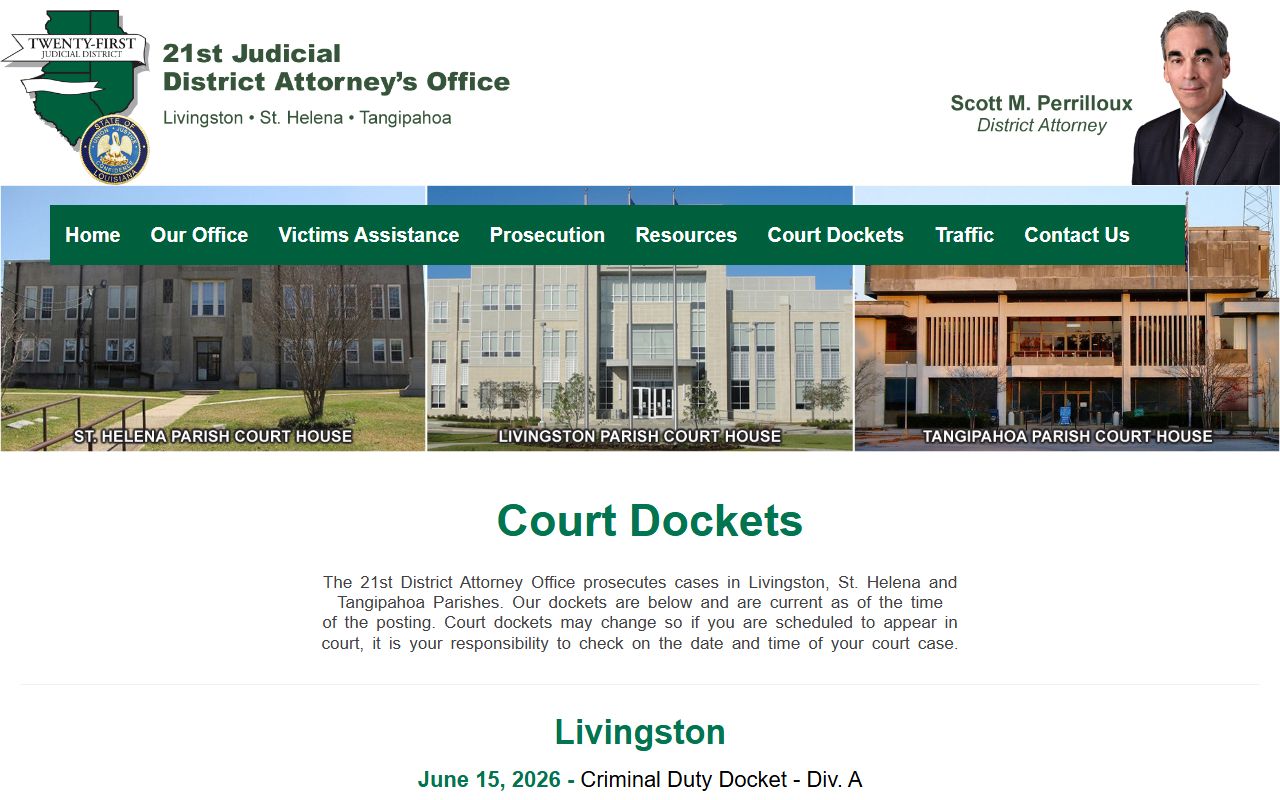
The docket image supports the court-records path because it shows the prosecutor's public docket channel rather than the jail roster.
St. Helena Court Search Fields
The research did not locate a single St. Helena-only criminal case search form with a detailed field inventory. It did identify portal and docket routes. Treat these as access channels, not guaranteed complete databases. When exact case retrieval matters, use the clerk's index process and provide enough identifying detail to separate people with similar names.
| Source | Search Type | Notes |
|---|---|---|
| Clerk Connect | Portal, likely account or subscription | Services vary by participating clerk and may include criminal cases. |
| eClerks LA | Statewide portal | Landing page advertises criminal-record searches across Louisiana parishes. |
| 21st JDA dockets | Posted date and division links | St. Helena criminal duty dockets are posted, and dockets may change. |
| Clerk index | Office records lookup | The clerk page says documents are located by indexes and no public terminals are available. |
Charges Filed After Arrest
The arrest-to-court pathway has stages. A booking charge is the allegation entered when a person is jailed. A court charge is the formal accusation that moves through the clerk and court docket after prosecutor action. In Louisiana felony practice, a bill of information or indictment may be used, while complaints or affidavits can appear early in the process depending on the charge and court stage. The exact document in a St. Helena case should be confirmed through the clerk or docket.
| Document | Who Uses It | What It Does |
|---|---|---|
| Complaint or affidavit | Officer, complainant, or prosecutor path | Sets out the early allegation or sworn facts tied to arrest. |
| Bill of information | Prosecutor | Formally files many Louisiana criminal charges without a grand jury indictment. |
| Indictment | Grand jury | Charges serious matters after grand jury action. |
St. Helena Charge Status
Court records after a jail arrest change as the case moves. A charge can be pending, amended, reduced, dismissed, or marked nolle prosequi if the prosecutor declines to continue that charge. The roster should not be used as the final word on case outcome. Court records are the place to verify whether the charge remains active, was resolved by plea or trial, was dismissed, or is eligible for later expungement.
| Status | What It Means |
|---|---|
| Pending | The charge is still open and has not reached final disposition. |
| Amended or reduced | The prosecutor or court record changed the charge from the arrest-stage allegation. |
| Dismissed | The charge was ended by court order or prosecutor action. |
| Nolle prosequi | The prosecutor chose not to pursue the charge at that time. |
| Convicted | A guilty plea, verdict, or adjudicated outcome was entered. |
Arrest to First Appearance
Louisiana Code of Criminal Procedure article 230.1 affects St. Helena Parish court records after a jail arrest because it sets the early judge-appearance rule. The sheriff or officer with custody must bring an arrested person before a judge promptly, and in any case within 72 hours from arrest, excluding Saturdays, Sundays, and legal holidays. At that appearance, counsel can be addressed and bail can be determined or reviewed. If the required appearance does not occur, the statute provides for release on recognizance, without invalidating later proceedings.
Bond details can be separate from the court charge status. A cash bond, surety bond, recognizance release, property security, or no-bond hold depends on the court order and any detainer or warrant. A posted bond may not release someone if another parish, probation or parole officer, DPS&C, USMS, or ICE has an active hold.
Bond After St. Helena Arrest
For a St. Helena Parish jail arrest, confirm custody first, then ask whether bond has been set. The sheriff or jail can confirm local custody and whether a hold prevents release. The court or clerk can help identify the case, judge setting, and formal court record. Louisiana allows commercial bail bonding, but the research did not locate a St. Helena-specific bond window, accepted payment method list, cashier's-check rule, or 24-hour bond counter instruction.
| Bond Type | How It Works |
|---|---|
| Cash bond | The full security amount is paid under local court or sheriff rules. |
| Surety bond | A licensed or approved surety guarantees the person's court appearance. |
| Recognizance or PR | The person is released on a promise to appear, sometimes with conditions. |
| No-bond hold | A court or agency hold blocks release even if other charges have bond. |
Warrants and Arrest Records
No official St. Helena Parish active warrant search page was located. The jail roster may show a person after booking on a warrant, but it is not an active warrant database. A bench warrant can stem from a missed court date in the 21st JDC, while an arrest warrant authorizes custody, a search warrant authorizes a search, and a fugitive warrant or hold can involve another jurisdiction. For a warrant question, contact counsel, the issuing court or clerk, or the sheriff before appearing in person.
Charges Versus Convictions
Court records after arrest must be read by stage. A person can be arrested and charged without being convicted. A roster charge can be changed by the prosecutor. A court charge can be dismissed, amended, reduced, or resolved by plea or trial. Only a final guilty plea, verdict, or adjudicated outcome should be treated as a conviction.
| Charge | Conviction | |
|---|---|---|
| Stage | Accusation or filed count | Final guilty outcome or verdict |
| Proof | Allegation or probable cause stage | Resolved under criminal court standards |
| Record source | Roster, DA filing, or court docket | Final court disposition |
Sealed and Expunged Records
Louisiana expungement rules affect public access after some dismissals, set-asides, clean waiting periods, or pardons. La. C.Cr.P. art. 978 governs felony expungement eligibility with exclusions, and Louisiana State Police materials explain that expunged arrest and conviction records are removed from public access but not destroyed. Certain criminal-justice and licensing entities may still see records under Louisiana law. For a St. Helena case, use the clerk and court record to verify the disposition before assuming a record can be expunged.
| Sealed or Restricted | Expunged | |
|---|---|---|
| Public view | Hidden or limited by court order or statute | Removed from public access under Louisiana expungement rules |
| Agency view | Some agencies may retain access | Specified criminal-justice and licensing entities may retain access |
| Best source | Clerk or court order | Clerk, court order, and Louisiana State Police guidance |
Public Record Search
Sponsored Results